


Section 1
PFAS
The Global Chemical Challenge Threatening Health and the Environment


Section 1
PFAS: The Global Chemical Challenge Threatening Health and the Environment
What Are PFAS and Why Are They a Problem?
Per- and polyfluoroalkyl substances (PFAS), often referred to as “forever chemicals,” [1] are synthetic compounds prized for their water- and grease-resistant properties. Since their first synthesis in the 1930s, they’ve been used in countless everyday products—from non-stick cookware and waterproof clothing to firefighting foams and food packaging.
But the very same stability that makes PFAS useful also makes them nearly impossible to break down. Over decades, PFAS have spread across soil, air, and water systems worldwide, turning into one of the most pressing environmental issues of our time.
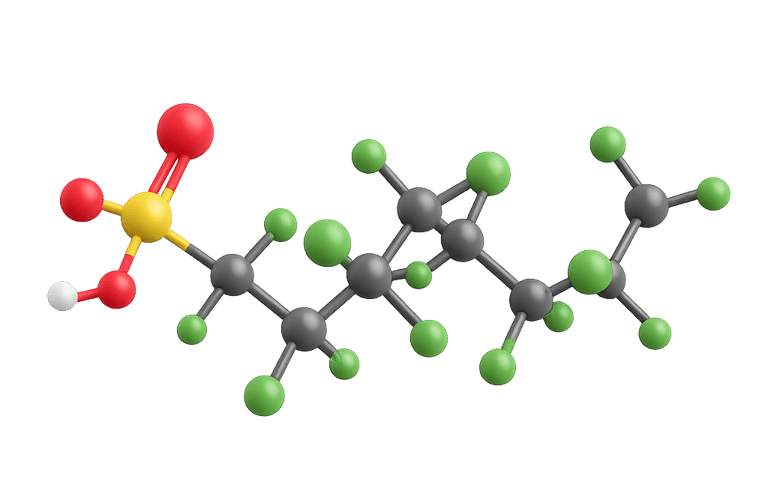
By the year 2000, PFAS compounds like PFOA (perfluorooctanoic acid) and PFOS (perfluorooctane sulfonic acid)had been detected globally. Their resilience means they accumulate in ecosystems and the human body, creating serious health and environmental challenges.
PFAS Contamination Across the Environment
PFAS are now found almost everywhere:
Watersheds: Strict regulations are forcing improved treatment for drinking and reuse water.
Soil: Industrial and defence sites face cleanup liabilities.
Air: PFAS spread during manufacturing and through refrigerant emissions.
Wastewater: Landfill leachate and industrial discharges contaminate treatment systems.
Concrete and Infrastructure: Airfields and refineries face embedded contamination.
Crops and Food: Irrigation and biosolid use have raised fears of PFAS entering the food chain.
The challenge is global—and the ingenuity that created PFAS is now being redirected toward eliminating them.
Understanding the Different Types of PFAS
PFAS share a defining feature: strong carbon-fluorine bonds, among the most stable in chemistry. The OECD defines PFAS as fluorinated substances containing at least one fully fluorinated methyl or methylene group.
There are two main categories of PFAS:
Polymers – often used in industrial coatings.
Non-polymers – the focus of environmental regulations due to their persistence and toxicity.
Non-polymers are further divided into:
Perfluoroalkyl substances, where all hydrogen atoms are replaced by fluorine.
Polyfluoroalkyl substances, where only some carbons are fully fluorinated.
Among these are PFAAs (perfluoroalkyl acids), which include:
PFCAs (perfluoroalkyl carboxylic acids)
PFSAs (perfluoroalkyl sulfonic acids)
Long-chain PFAS (such as PFOS and PFOA) are more persistent and bioaccumulative, while short-chain PFAS are being increasingly detected due to shifts in manufacturing.
Researchers estimate there are over 27,000 types of PFAS, though experts argue that regulation should focus on the roughly 256 most commonly used variants.
Health Risks Linked to PFAS Exposure [2]
Scientific research continues to uncover how PFAS affects the human body. Studies have connected PFAS exposure to:
Increased cholesterol levels
Liver and kidney toxicity
Thyroid disruption
Immune system suppression
Reproductive and developmental harm
Certain cancers
Human exposure typically involves multiple PFAS compounds, making it difficult to isolate exact dose-response relationships. Still, the most consistent findings for PFOS and PFOA include elevated cholesterol, higher uric acid, decreased birthweight, increased liver enzyme levels, and reduced vaccine response.
While more research is needed, the bioaccumulative nature of PFAS means they can remain in the body for years, compounding long-term risk.
How the World Is Regulating PFAS
PFAS regulation is evolving rapidly around the globe, focusing on three major areas:
Product control
Drinking water limits
Environmental cleanup standards
In 2000, 3M announced it would phase out PFOS production. By 2022, the company pledged to stop all PFAS manufacturing by 2025. The US EPA has since introduced some of the world’s strictest drinking water limits—4 ng/L for PFOA and PFOS—and several states have enacted bans on PFAS in consumer goods and firefighting foams.
Europe and the UK
The Stockholm Convention [4] lists PFOS, PFOA, and PFHxS as persistent organic pollutants. The EU and UK, through REACH and CLP regulations, are exploring a broad ban on PFAS, including polymers, though temporary exemptions remain for critical uses.
Australia began restricting PFAS imports in 2002 and will ban PFOS, PFOA, and PFHxS from July 2025 under the Industrial Chemicals Act and Environmental Management Register Act.
Since 2016, Canada has prohibited PFOS, PFOA, and long-chain PFCAs, with newer regulations in 2025 classifying PFAS as a toxic class under the Canadian Environmental Protection Act (CEPA).
Global PFAS Drinking Water Standards
Around the world, governments are tightening drinking water guidelines to protect public health:
World Health Organization (WHO): 100 ng/L total PFAS (draft) [7]
European Union: 100 ng/L for 20 PFAS and 500 ng/L total PFAS [8]
Australia: perfluorooctane sulfonic acid (PFOS) – 8 nanograms per litre, perfluorooctanoic acid (PFOA) – 200 nanograms per litre, perfluorohexane sulfonic acid (PFHxS) – 30 nanograms per litre, perfluorobutane sulfonic acid (PFBS) – 1000 nanograms per litre. [11]
These increasingly strict standards reflect growing concern about PFAS contamination and its link to chronic diseases.
PFAS Cleanup and Remediation Efforts
Cleaning up PFAS is one of the biggest environmental challenges of the 21st century. Because PFAS resist degradation, they persist in soil, groundwater, and wastewater for decades.
Countries are adopting a risk-based, site-specific approach:
The US EPA provides compound-by-compound ecological guidance.
The Australian PFAS National Environmental Management Plan (NEMP), updated in 2025, offers standards for investigation and cleanup.
Canada now treats PFAS as a toxic class, enforcing emission controls and waste management.
Europe applies both PFAS-specific and general chemical risk frameworks, depending on the country.
These global efforts aim to reduce exposure, restore contaminated land, and protect wildlife and communities from PFAS accumulation.
The Road Ahead: Combating “Forever Chemicals”
PFAS represent one of the most complex environmental and public health challenges of our time. While regulations and awareness are improving, effective solutions will require collaboration between scientists, governments, and industries.
New technologies for PFAS destruction, remediation, and substitution are emerging, but widespread implementation remains a work in progress. As understanding deepens, so too does the global commitment to reduce—and ultimately eliminate—these persistent pollutants.
Updated: 5 December 2025
Section bibliography


Environmental Approach
Global Research


Section 1
PFAS
The Global Chemical Challenge Threatening Health and the Environment
Updated: 5th Dec 2025


Section 2
Global PFAS Regulations
How Countries Are Responding to the Forever Chemicals Crisis
Updated: 5th Dec 2025


Section 3
How Businesses Can Identify and Manage PFAS Risk
From Exposure Pathways to Sampling Best Practices
Updated: 1st Dec 2025
Section 4
The Science of Detecting PFAS
How Sampling and Analysis Shape the Fight Against Forever Chemicals
Updated: 8th Dec 2025


Section 5
Breaking Down Forever Chemicals
The Latest PFAS Treatment and Remediation Technologies
Updated: 1st Dec 2025






Section 6
The Future of PFAS Management
From Corporate Responsibility to Global Elimination
Updated: 1st Dec 2025
Section 8
Leading Through Change
How Companies Can Future-Proof Against PFAS Risks
Updated: 1st Dec 2025


Section 9
The Next Phase of the PFAS Response
Turning Knowledge Into Action
Updated: 1st Dec 2025 Find Out More >


Take Action
Address
London, United Kingdom
Contact

Copyright © 2026 2Encapsulate Limited. All rights reserved.